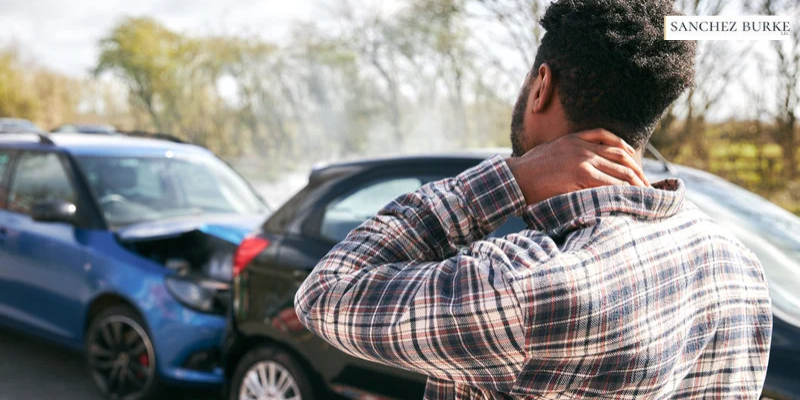
Right after a crash, evidence is the last thing on your mind. You’re checking your neck, staring at your bumper, waiting for the ambulance. But the case you’ll have eight months from now gets decided by what gets captured in the next eight hours.
A surveyor’s whole job, whether on a job site or a ship deck, is measuring what’s there before it moves or disappears. Skid marks fade. Debris gets swept. Memories blur within days. That same instinct, treating a crash scene like a set of fixed measurements instead of a fuzzy memory, is what separates a claim that gets paid from one an insurance company picks apart.
Sanchez Burke, LLC applies that kind of precision to Louisiana injury claims. Contact our firm today before that window closes.
Key takeaways:
- Physical evidence like skid marks, debris, and vehicle position starts changing within hours, sometimes before the tow truck even shows up.
- A voice memo recorded at the scene holds up better in a dispute than a written statement drafted three days later.
- Louisiana’s comparative fault rule now bars recovery entirely if you’re found 51% or more at fault, so your evidence has to do more work than it used to.
- Medical treatment within 24 hours creates a timestamped link between the crash and your injury that adjusters can’t easily argue away.
- You now have two years, not one, to file a Louisiana injury lawsuit, but evidence doesn’t wait that long to vanish.
A car accident evidence attorney at Sanchez Burke, LLC can start locking down proof while it still exists. Contact our firm today.
What Evidence Actually Wins a Louisiana Injury Case
A case isn’t won by how badly you were hurt. It’s won by how clearly the proof ties someone else’s carelessness to the harm you’re carrying now.
Insurance adjusters are trained to hunt for the weak link in that chain, the missing photo, the witness nobody called, the gap between the crash date and your first doctor visit. Under Louisiana’s comparative fault system, courts now determine the percentage of fault for everyone involved, and if you are found 51 percent or more at fault, you cannot recover any compensation, and this modified rule applies to incidents that occur on or after January 1, 2026, under Louisiana Civil Code article 2323. That single number is exactly why the evidence you gather in the first few hours matters more than most people realize.
The Surveyor’s Method: Fixed Points Before Anything Moves
A surveyor never trusts a single photo.
Before anything gets measured, they anchor to something permanent, a manhole cover, a light pole, a mile marker, so every later measurement can be checked against a fixed spot. At a crash scene, that same habit turns “the car was kind of over there” into a number someone can verify months later, long after the vehicles are gone, and the road’s been repaved. Most guides tell you to take pictures. Few explain that a photo without a fixed reference point is just an impression, not a measurement anyone can rebuild in court.
Physical Evidence That Disappears Fast
Some of the strongest proof in a crash case has a shelf life measured in hours, not weeks.
- Skid marks and gouge marks wash away with rain or get worn off by traffic within a day or two.
- Debris fields get swept up by road crews once the scene is cleared.
- Vehicle position and damage change the moment a car gets towed or repaired.
- Road and signal conditions, like a burned-out streetlight or a missing stop sign, can get fixed before you ever return.
- Weather at the time of impact is nearly impossible to reconstruct later without notes or timestamps.
Once any of these are gone, they’re gone. A car accident evidence attorney can dispatch someone to document what’s left before it disappears entirely.
Witness Statements and Digital Footage
Human memory and machine memory both fade, just on different timelines, and both need to be captured before they do.
Getting Witnesses on Record
Witness memories fade fast, and their accounts about speed, driver behavior, or road conditions grow less reliable within days. Getting names, numbers, and a quick recorded statement at the scene, or shortly after, locks in details before they blur together.
Traffic Cameras, Dashcams, and Black Boxes
Nearby traffic and security cameras can hold footage that resolves disputes over fault, but most systems overwrite recordings within days unless someone requests preservation. When a case turns technical, reconstruction professionals rely on physics and engineering principles, calculating forces and analyzing tire marks and vehicle angles to determine the sequence of events.
Medical Records: The Paper Trail That Proves Your Injury
Medical records do one job in an injury case: they prove the crash caused the harm, not something that happened before or after it.
A same-day or next-day exam creates a timestamped document connecting your body to the collision, which matters because whiplash and soft tissue injuries often don’t show symptoms right away. Wait four days, and an adjuster will argue something else caused it. Every bill, diagnosis, and follow-up note after that builds the financial and physical record your claim depends on.
According to the Centers for Disease Control and Prevention, there were over 3.8 million emergency department visits for injuries from motor vehicle crashes in one recent year, which is part of why insurers scrutinize medical documentation so closely.
How Louisiana’s Comparative Fault Rule Changes the Evidence You Need
Louisiana used to let you recover something even if you were mostly at fault. That changed.
As of January 1, 2026, Louisiana closed the chapter on its long-standing pure comparative fault system and moved to a modified approach that bars recovery once a plaintiff is found 51% at fault. If your assigned share of fault reaches that 51 percent mark, your claim is worth nothing, no matter how serious the injury.
That makes every fixed measurement, every witness contact, and every photo from the scene part of an argument about percentages, not just facts.
If your case ends up contested, it will likely be heard in the 14th Judicial District Court in Calcasieu Parish, which is one of Louisiana’s judicial districts and has original jurisdiction of all civil and criminal matters in Calcasieu Parish, where judges apply this standard the same way courts do statewide.
When Evidence Disappears: Spoliation Letters and Deadlines
Two things can quietly kill a strong case: lost evidence and missed deadlines.
- Spoliation letters put the other side on formal notice not to repair, alter, or destroy evidence like a vehicle or dashcam footage.
- Prescription deadlines in Louisiana now give you two years from the date of injury to settle or file suit, under Louisiana Civil Code article 3493.1, longer than the old one-year rule.
- Waiting too long to send a preservation request means footage gets overwritten and debris gets cleared, no matter how much time remains on the legal deadline.
A car accident evidence attorney can send these letters immediately, which matters more than the extra year most people now assume they have. Contact our firm today before proof you need starts slipping away.
FAQs About Car Accident Law
How long do I have to file a car accident lawsuit in Louisiana?
You’ve got two years from the date of the crash to settle or file suit. That is under Louisiana Civil Code article 3493.1, which provides that delictual actions are subject to a liberative prescription of two years and was enacted by Acts 2024, No. 423, effective July 1, 2024, replacing the old one-year rule. Waiting even close to that deadline is risky, since gathering evidence gets harder the longer you wait.
What if I didn’t get the other driver’s insurance information at the scene?
You or your attorney can usually get it later through the police report. Louisiana officers document driver and insurance details when they respond to a crash. It’s not ideal to miss it at the scene, but it’s rarely a dead end.
Can surveillance footage still be recovered after it’s been overwritten?
Once footage is overwritten, it’s typically gone for good. Most business and traffic cameras cycle their storage within days, sometimes hours. That’s why sending a preservation request fast matters more than almost anything else you can do after a crash.
Do I need to hire an accident reconstruction expert for every case?
No, most cases settle without one. Reconstruction experts get brought in for serious injury or fatality cases where fault is disputed and physics can settle the argument. Whether you need one usually comes down to how much the insurance company is fighting you.
Sanchez Burke, LLC: Your Louisiana Personal Injury Law Firm
You came here because you’re staring at a crash scene, wondering if what you’ve got is enough to prove what happened. Most of the time it isn’t, not because the facts don’t support you, but because the proof that would have supported you was never locked down before it faded.
That’s the gap our team works to close, moving quickly to document scenes, request footage before it’s erased, and connect medical records to the moment of impact. Louisiana’s comparative fault rule means the details matter more than ever.
Contact our firm today, and let’s start building your case while the evidence is still there to build it on.