
Speak To An
Attorney Now 337-433-4405
Lake Charles Longshore and Harbor Workers’ Compensation Lawyer
Dedicated Lake Charles Longshore and Harbor Workers’ Compensation Attorney
If you work on a dock, terminal, or berth along the Calcasieu Ship Channel and got hurt on the job, the insurance carrier assigned to your claim is not there to help you. Their job is to limit what they pay.
Louisiana workers’ comp excludes these claims. Instead, these claims fall under the federal Longshore and Harbor Workers’ Compensation Act (LHWCA), a separate federal law that typically provides superior benefits. Carriers often challenge jurisdiction immediately to avoid these higher payouts.
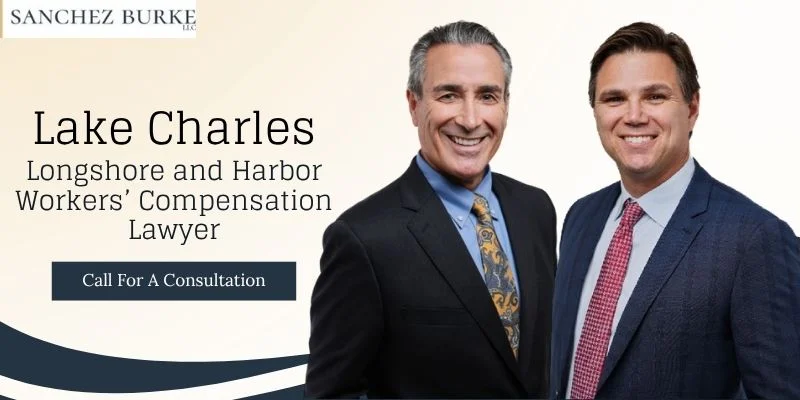
Our Lake Charles longshore and harbor workers’ compensation lawyers have handled maritime injury claims along the Calcasieu Ship Channel for years and know how carriers build their early arguments. Tell us what happened, and we’ll give you a straight read on your claim in a free case evaluation.
We work LHWCA cases on contingency: nothing out of pocket unless we recover for you.
What Joe Burke Brings to Your Longshore and Harbor Worker Claims
Joe Burke’s background on the water gives him a perspective few maritime attorneys can match.
- Professional Experience: Before becoming an attorney, Joe served as a professional hydrographic surveyor for the U.S. Navy and U.S. Department of Commerce, where he created nautical charts and surveyed the site of the Exxon Valdez grounding.
- Legal Education: He holds a J.D./D.C.L. dual degree from LSU and was a member of the LSU Admiralty Moot Court team.
- Advocacy: Joe combines this on-the-water industry expertise with legal knowledge to provide relentless advocacy for complex maritime claims.
Paired with Walt Sanchez’s 40+ years of trial experience, your claim gets both technical precision and courtroom authority.
Who Our Lake Charles Workers’ Comp Attorneys Represent Under the Longshore Act in Southwest Louisiana
The LHWCA covers maritime workers who are not considered seamen under the Jones Act. If your work is on or near navigable waters and involves traditional maritime duties, the Longshore Act likely applies.
We represent multiple categories of workers, including:
- Longshoremen and cargo handlers injured during loading or unloading operations at Port of Lake Charles or the Calcasieu Ship Channel.
- Ship repairers and shipbuilders injured in dry dock or repair yard environments along Louisiana waterways.
- Harbor construction workers injured while building, expanding, or maintaining docks, piers, and terminal infrastructure.
- LNG terminal workers employed at Cameron Parish liquefied natural gas facilities who are injured in areas that adjoin navigable waters.
- Barge and tug support crews performing land-based or dock-side duties that directly support vessel operations.
- Heavy equipment operators and stevedores whose work is directly tied to maritime cargo operations.
One question our lawyers answer first for every client: Does your situation fall under the LHWCA, the Jones Act, or Louisiana workers’ compensation? The answer determines the benefits available to you, and each path is different. We sort that out before anything else.
What You Stand to Lose If You Mishandle an LHWCA Claim
Louisiana state workers’ compensation caps your lost-wage benefits and ends them after a set period. The federal LHWCA does not cap in the same way.
For workers with a qualifying permanent total disability, benefits can continue for as long as the disability lasts, with annual cost-of-living adjustments. In practice, for a worker who cannot return to work and whose condition does not improve, this can mean benefits for life. That difference is real money for a worker with a serious injury.
Under the Longshore and Harbor Workers’ Compensation Act (33 U.S.C. §§ 901-950), qualifying injured workers are entitled to:
- Lost wage replacement: Two-thirds of your average weekly wage while you cannot work, subject to annual federal adjustments. For the benefit year beginning October 1, 2025, the maximum weekly rate is $2,082.70 (S. Dept. of Labor, Notice No. 207, Sept. 17, 2025).
- Full medical care: Your employer must cover all reasonable and necessary treatment, and you have the right to choose your own treating physician.
- Vocational rehabilitation: If the injury prevents you from returning to your previous job.
- Permanent disability benefits: Calculated on your actual loss of earning capacity if you cannot fully recover.
- Death benefits: A surviving spouse typically receives 50% of the worker’s average weekly wage. Each surviving child receives an additional 16⅔%. Total weekly death benefits cannot exceed the lesser of the worker’s average weekly wage or 200% of the national average weekly wage. Reasonable funeral expenses are also covered.
With some exceptions, you must report the injury within 30 days and file a formal claim with the U.S. Department of Labor within one year. Miss either deadline and the carrier will use it against you.
How We Handle LHWCA Claims in Calcasieu and Cameron Parishes

Federal LHWCA claims are processed through the U.S. Department of Labor’s Office of Workers’ Compensation Programs, with claims filed through the Department’s Southern District office in New Orleans, Louisiana. The process differs from state workers’ comp, and paperwork or timing errors can delay or kill your benefits.
- Case evaluation: We identify whether your claim falls under the LHWCA, Jones Act, or Louisiana workers’ comp before a single form is filed. In some cases, more than one legal claim is available simultaneously.
- Employer and carrier notification: We handle all required notices to your employer and their insurer within the federal deadlines.
- Claim filing: We prepare and file Form LS-203 with the U.S. Department of Labor on your behalf.
- Medical advocacy: We work to make sure your treating physician of choice is recognized and that medically necessary treatment is not improperly denied.
- Dispute representation: If the carrier files a Notice of Controversion (Form LS-207) denying your claim, we request an informal conference and, if needed, a formal hearing before a Department of Labor Administrative Law Judge.
- Third-party claims: If a vessel owner, equipment manufacturer, or other contractor contributed to your injury, you may have a separate civil lawsuit available on top of your LHWCA benefits. We identify and pursue both where applicable.
Contact our LHWCA attorneys in Lake Charles now for a free consultation and learn where your claim stands.
FAQs About Lake Charles, LA Longshore and Harbor Workers’ Compensation Claims
What is the difference between the LHWCA and the Jones Act for Louisiana maritime workers?
The Jones Act covers seamen: workers who spend a significant portion of their time aboard a vessel in navigation. The LHWCA covers dock workers, terminal workers, ship repairers, and others who work on or near navigable waters but are not seamen. The two laws are mutually exclusive. If you qualify under the Jones Act, you can sue your employer directly for negligence. Under the LHWCA, you generally cannot sue your employer directly for damages, unless your employer is also the owner of the vessel that caused your injury.
The insurance carrier denied my claim. What can I do?
When a carrier denies a claim, they file a Notice of Controversion (Form LS-207). You then have the right to request an informal conference through the U.S. Department of Labor’s OWCP office in New Orleans. If that does not resolve the dispute, you can request a formal hearing before an Administrative Law Judge. Having an experienced attorney at that stage makes a significant difference.
How long do I have to file an LHWCA claim?
You must notify your employer within 30 days of the injury. For most injuries, you must file a formal claim within one year of the injury. For occupational diseases, hearing loss, or conditions that develop gradually over time, the deadline extends to two years from the date you knew, or reasonably should have known, that your condition was connected to your work.
What does an LHWCA case cost me?
We handle LHWCA claims on a contingency basis: you pay no attorney fee unless we recover benefits for you. Under federal law, attorney fees in LHWCA cases are subject to approval by the Department of Labor to ensure they are reasonable. Contact us for a free, no-obligation evaluation of your claim.
Talk to a Lake Charles Longshore and Harbor Workers’ Compensation Attorney
You reported to work. You were hurt. What happens next should not be left to a claims adjuster who works for your employer. Sanchez Burke has handled complex maritime and federal law cases in Southwest Louisiana for decades, and Joe Burke brings a background in the waterways themselves that few Lake Charles personal injury attorneys can match.
Your 30-day reporting deadline may already be running. Contact us today for a free case evaluation. We serve clients throughout Calcasieu, Cameron, and Jefferson Davis Parishes and across Acadiana from offices in Lake Charles and New Iberia.
Sanchez Burke
Free Consultation With A Lake Charles
Attorney Who Can Help
For a free initial consultation, contact our Louisiana law firm online today or call us to speak with one of the firm’s talented attorneys.
awards & affiliations






1200 Ryan Street
Lake Charles, LA 70601
223 East Main Street
New Iberia, LA 70563
Schedule A Consultation
337-433-4405
Copyright © 2026 Sanchez Burke, LLC• All Rights Reserved.
*Images are obtained under license from Canva and other third-party stock image providers, with attribution included where required.
Digital Marketing By 